
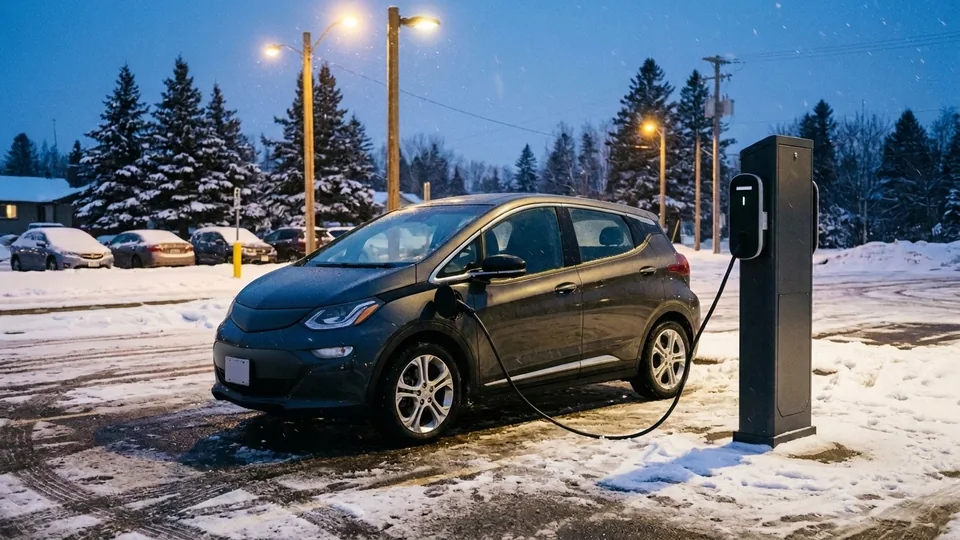
Electric Vehicle Charging Economics & Cold-Weather Realities Across Canada
Driving an electric vehicle (EV) in Canada delivers some of the largest per-kilometre fuel savings in the world thanks to competitive residential electricity tariffs from coast to coast—yet sub-zero winter physics dramatically change both charging time and energy consumed at the plug. Between November and March across Ontario, Quebec, the Prairies, and Northern BC, cold-soaked Lithium-Ion or LFP packs lose chemical ion mobility until thermal management heaters bring cell packs above 15 °C–25 °C.
Measuring realistic charging costs in Canadian dollars ($ CAD) and session duration requires factoring in four uniquely Canadian parameters: regional residential hydro/kWh rates versus commercial public fast-charger tariffs regulated by Measurement Canada, charger power delivery (120 V Level 1, 240 V Level 2 home wallboxes, or 50–350 kW DC corridors like Hydro-Québec Circuit électrique, FLO, Ivy, Electrify Canada, and Tesla Superchargers), cabin/battery heating overhead, and severe windchill temperatures below −20 °C.
Level 1 vs Level 2 Home Charging Under −20 °C Canadian Cold
- Level 1 (Standard 120 V / 12 A Outlet — ~1.4 kW): While viable in mild coastal Vancouver summers for drivers travelling under 50 km/day, Level 1 struggles sharply in −20 °C Winnipeg, Ottawa, Edmonton, or Montreal winters. Almost 1,000+ watts of that 1.44 kW outlet go strictly toward keeping the high-voltage battery warm before charging electrons even accumulate, leaving tiny net range gain overnight.
- Level 2 (240 V / 32 A–48 A Home Wallbox — 7.2 kW to 11.5 kW): Gold standard across Canadian winter driveways. A 7.2 kW–11.5 kW CSA-certified EVSE heats a chilled 77–85 kWh battery briskly within the first 20 minutes while completing a 20% → 80% overnight top-up in roughly 5 to 7 hours—easily fitting entirely inside Ontario’s Ultra-Low Overnight window or Hydro-Québec’s off-peak schedule.
- Public DC Fast Charging (50 kW, 150 kW & 350 kW Pedestals): Under updated Measurement Canada regulations rolled out across Canada, most modern public DC dispensers now bill per kilowatt-hour ($/kWh) rather than strictly per-minute—or combine kWh rates with idle/tier fees. Even on a 250 kW dispenser, plugging in with a "cold-soaked" battery straight out of a frozen hotel lot without using in-car navigation battery preconditioning typically throttles initial DC intake from 150+ kW down to 35–55 kW until the pack warms up, doubling stop time from 28 minutes to nearly an hour.
Provincial Home EV Charge Cost vs Gasoline Equivalent Comparison ($ CAD)
| Province / Utility Benchmark | Typical Residential Night / Tier Rate | Cost for 60 kWh Top-Up (~300 km Summer / ~215 km Winter) | Equiv. Gasoline SUV Cost (@ $1.60/L, 9L/100km) |
|---|---|---|---|
| Quebec — Hydro-Québec Rate D Tier 1 | ~$0.067 / kWh | ~$4.40 CAD (incl. 10% charging loss) | ~$31–$43 CAD |
| Ontario — Ultra-Low Overnight (ULO) | ~$0.028 / kWh (11 p.m. – 7 a.m.) | ~$1.85 CAD (excl. volumetric delivery) | ~$31–$43 CAD |
| Manitoba — Manitoba Hydro | ~$0.099 / kWh | ~$6.50 CAD | ~$31–$43 CAD |
| British Columbia — BC Hydro Step 1/2 | ~$0.109 – $0.141 / kWh | ~$7.20 – $9.30 CAD | ~$34–$46 CAD (higher BC fuel prices) |
| Public DC Fast Charger (Canada Average) | ~$0.38 – $0.58 / kWh | ~$25 – $38 CAD | ~$31–$43 CAD |
4 Best Practices for Sub-Zero Canadian Highway EV Road Trips
- Always Navigate to the Fast Charger via In-Vehicle Maps: On Tesla, Hyundai Ioniq 5/6, Kia EV6/EV9, Ford Lightning/Mach-E, Volvo, and GM Ultium models, routing directly to a mapped DC fast station triggers automatic battery preconditioning 20–45 minutes prior to arrival, warming cells so your vehicle pulls peak kilowatts immediately upon plugging in.
- Charge When Returning With a Warm Battery (Not Before Leaving Cold): Never arrive home at 12% in −25 °C expecting to top up smoothly at a morning DC charger before work. Plug in immediately at the end of a highway drive while battery cells are already near 15–20 °C.
- Check Local Corridor Uptime Before Leaving Small Towns: Remote highways across Northern Ontario (Highway 17 / 11 between Sault Ste. Marie, Wawa, and Thunder Bay), the Coquihalla, and Eastern Quebec rely on 1–2 dispensers per rest stop. Always inspect live network status on our Canada EV Charging Network Status Monitor and carry an adapter (NACS-to-CCS1 or J1772) in your sub-trunk.
- Use Scheduled Departure Inside the Garage Before Unplugging: Pre-heating the cabin while still connected to your 240 V wallbox draws winter warmup kilowatts from utility lines (~$0.30–$0.60 CAD) instead of draining 8–12% of stored driving range on the road.
Why Public DC Chargers Fail or Throttle During Power Grid Disruptions
Commercial fast-charging hubs run on heavy 480 V–600 V three-phase utility feeds and cellular telematics modems to validate RFID cards and mobile apps. During severe provincial windstorms, freezing rain, or cellular LTE backhaul outages in rural corridors, a charging pedestal may remain physically powered while showing "Communication Error" in the mobile app because payment authorization cannot reach cloud servers. Monitoring both regional electricity reliability and wireless carrier disruptions prevents getting stranded at offline pedestals during major storm events.
Understanding Measurement Canada Per-kWh Fast Charger Billing & Idle Fees
Until recently, Canadian public fast-charging operators billed drivers strictly by the minute because legacy Measurement Canada regulations did not authorize kWh electricity resale by non-utilities. Following federal regulatory updates, major networks (Flo, Electrify Canada, Ivy, Circuit électrique ultra-fast dispensers, and Tesla Superchargers) have transitioned toward certified per-kWh billing across Ontario, Quebec, British Columbia, and Alberta. Under kWh billing, winter cold-soaked charging slower at 40 kW no longer punishes drivers per minute for thermal physics—though time-based congestion or idle fees still apply once your battery reaches completion and blocks a stalled dispenser.
Before locking in a residential Level 2 charger purchase, pair this session calculation with our Canadian Electricity kWh Cost Calculator to compare how overnight Ontario ULO or Quebec Tier 2 kilowatt-hours affect your total monthly utility statement. Remember as well that most Canadian home 200-amp electrical panels allow a standard 40 A or 48 A continuous circuit without costly utility service mast upgrades, whereas older 100-amp urban panels in Montreal triplexes or pre-1980 Toronto semis frequently install an Energy Management System (EVEMS / load-sharing controller) certified under the Canadian Electrical Code to avoid exceeding panel breaker ratings safely.