
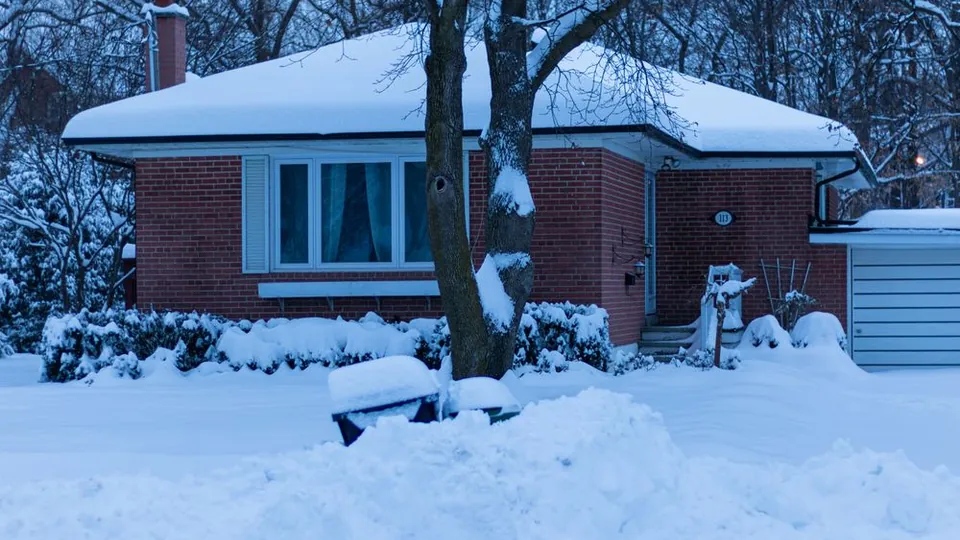
Thermal Mass Physics During a Canadian Polar Vortex Blackout
When utility power drops while outside air plunges to -20°C or -35°C, a modern Canadian R-2000 or post-2010 building loses roughly 0.5°C to 1.2°C per hour depending on wind speed. Older century brick homes, cantilevered dining-room bump-outs, attached garages with upper bedrooms, and lakefront cottages lose warmth significantly faster. Within 12 to 24 hours without heat, interior wall cavities along north- and west-facing exterior corners drop below 0°C—creating severe risk of copper or PEX pipe rupture long before central hallway thermostats touch freezing.
Step 1: Consolidate Warmth into One Insulated Refuge Zone
- Close interior doors, curtains, and basement stairways: Concentrate family members and pets inside a single central or south-facing interior room rather than leaking residual warmth into empty guest bedrooms and high-ceiling entryways. Stuff rolled bath towels tightly against gap bottoms of doors leading to unheated mudrooms or garages.
- Seal window radiation losses immediately: Close insulated cellular shades and heavy drapes at dusk across north- and wind-exposed glass. Open south-facing curtains solely while bright midday winter sunlight streams in for passive solar gain.
- Use indoor tents or canopy blankets safely for sleeping warmth: Setting up a small breathable pop-up camping tent or draping wool blankets over a dining table traps natural occupant body heat comfortably several degrees warmer than ambient air—keep flame sources completely away.
- Avoid deadly indoor heating improvisation: Never bring outdoor propane barbecues, charcoal hibachis, camping stoves, or unvented outdoor kerosene heaters inside a Canadian residence—carbon monoxide concentrates invisibly within minutes, particularly inside tight modern building envelopes.
Step 2: Protect Water Pipes From Freezing & Bursting
| Time Elapsed in Sub-Zero Temps | Plumbing Action Protocol |
|---|---|
| 0 – 6 Hours (Indoor 15°C+) | Open under-sink cabinet doors along exterior walls (kitchen, powder rooms, laundry walls) so remaining room air warms copper and PEX water risers. |
| 6 – 14 Hours (Indoor 5°C – 12°C) | Open both hot and cold taps on plumbing along exterior walls to a continuous thin trickle (moving water freezes slower and bleeds dangerous ice-plug expansion pressure backward). Ensure drains remain clear so sink overflow risks never compound freeze risks. |
| 14+ Hours / Evacuation (< 4°C) | Close the main municipal water shutoff valve near the basement floor/wall, shut off electric or gas hot water tank inputs, open every hot and cold tap from the top storey downward to drain pressurized lines by gravity, flush every toilet to empty tanks/bowls, and pour non-toxic pink RV/plumbing antifreeze into sink P-traps and toilet traps. |
Why Natural Gas Furnaces Still Need Electricity
Many Canadian homeowners are surprised when a modern high-efficiency condensing natural gas or propane furnace fails immediately during an electrical outage. Although Enbridge, Énergir, ATCO, and FortisBC buried gas mains stay fully pressurized underground, modern furnaces rely on 120 V AC electricity to drive the combustion inducer motor, excite silicon-nitride igniters, monitor optical flame rectification safety boards, open redundant gas solenoids, and rotate the ECM circulation blower. Running a furnace legally during hydro failures requires a CSA-approved generator transfer switch or properly bonded pure-sine inverter circuit wired by a licensed electrician—never splice extension cords illegally onto furnace boards.
Older standing-pilot millivolt wall heaters and select CSA-certified direct-vent propane fireplaces remain rare exceptions equipped with internal AA/D battery packs for thermostat ignition; clear snow drifts carefully off exterior exhaust terminations before igniting.
Frequently Asked Questions — Sub-Zero Blackouts
Should I thaw a frozen copper pipe with a propane torch?
Never use an open flame or blowtorch—hundreds of catastrophic Canadian winter structural fires ignite inside floor joists every cold snap this way. Open the downstream tap first so steam pressure escapes safely, then warm gradually using a hair dryer, heat tape, or warm towels working back from the faucet side toward the frozen wall section.
Will home insurance cover burst pipes if I leave during a multi-day storm?
Canadian residential insurance policies routinely enforce a Winter Freezing Exclusion clause after 48–96 hours away unless a reliable person inspects heating daily or the main water supply is shut off and all pipes drained. Closing the main valve and draining lines before leaving for a warming centre protects both home structure and claim eligibility.
Does leaving one kitchen tap dripping risk freezing my sewer line?
Normal indoor municipal sewer mains stay well below frost depth unless shallow uninsulated cottage drains sit exposed to sub-zero exterior air; drip slowly rather than leaving stagnant water trapped under full street pressure.
Canadian Provincial Utility Regulators & Insurance Documentation Checklist
When a storm or equipment fault disrupts hydro electricity for more than several hours across Canada, households often navigate both utility restoration queues and homeowner insurance assessments. Unlike minor retail service disruptions, provincial electrical distribution utilities—governed by regulators such as the Ontario Energy Board (OEB), Québec’s Régie de l’énergie, the British Columbia Utilities Commission (BCUC), the Alberta Utilities Commission (AUC), the New Brunswick Energy and Utilities Board (NBEUB), and the Nova Scotia Utility and Review Board (UARB)—follow strict force majeure tariffs. Consequently, weather-driven tree contact, freezing rain, salt fog, or lightning blackouts almost never trigger automatic utility bill refunds, making personal documentation essential for residential insurance endorsements.
5 Items to Document Before Utility Power Returns
- Exact Outage Timestamps by FSA: Screenshot your utility outage ticket ID alongside the timestamped neighbourhood log on OutageCanada’s live Power & Hydro tracker so claims adjusters can confirm area-wide outage duration exceeding policy waiting periods (commonly 24 or 48 continuous hours for frozen food endorsements).
- Fridge & Deep-Freezer Contents Inventory ($ CAD): Federal food-safety guidance notes a closed refrigerator keeps perishable food below +4°C for roughly 4 hours, while a full upright or deep-chest freezer preserves safely frozen states for 24 to 48 hours without opening doors. Photograph discarded spoiled food alongside grocery receipts before cleaning bins.
- Sump Pump & Sewer Backflow Damage Photos: Document basement water accumulation cleanly and note whether extended power failure disabled an unbacked electric sump pump; check if your Canadian policy carries a distinct Overland Water & Sewer Backup endorsement cap.
- Private Contractor Invoices (Master Electrician / ESA / RBQ): If an exterior weatherhead mast bent or pulled away from structural siding during wind or falling roof ice, retain itemized contractor invoices and municipal inspection permits issued by ECRA/ESA (Ontario), CMEQ/RBQ (Québec), Technical Safety BC, or provincial safety authorities.
- Generator Sizing & Transfer Verification: Review residential emergency wattage loads carefully with our Canadian Emergency Generator Sizing Calculator and inspect local fuel-stabilizer and CSA carbon-monoxide detector battery expiry dates every October before winter storms strike.
Provincial Emergency Warming Centres & Civic Check-Ins
During sub-zero multi-day blackouts, Canadian municipalities open public warming and charging centres inside community arenas, public libraries, and municipal halls—announced via municipal 311 lines, local radio on battery receivers, and Red Cross coordination desks. Check regularly on elderly neighbours, wheelchair users, and medically vulnerable residents relying on electrically powered oxygen or dialysis supplies.
Canadian Postal FSA Verification, Time-Zone ETR Accuracy & Community Alerts
Canada encompasses six distinct civil time zones stretching from Newfoundland Standard Time (NST, UTC-3:30) and Atlantic Time across the Maritimes through Eastern Time in Québec and Ontario, Central Time in Manitoba and Saskatchewan, Mountain Time in Alberta, and Pacific Time in British Columbia and Yukon. Whenever a carrier or municipal water utility posts an Estimated Time of Restoration (ETR) across bilingual alerts, verify carefully whether timestamps are expressed in local provincial time or national Eastern Time before scheduling generator refueling cycles or work-from-home calls.
Searching OutageCanada by your three-character Canadian Postal Forward Sortation Area (FSA) (such as M5V for Downtown Toronto, H2X for Montréal, V6B for Vancouver, T2P for Calgary, or B3J for Halifax) aggregates official utility feed telemetry, Environment and Climate Change Canada (ECCC) GeoMet weather advisories, and verified local community problem reports into a single privacy-preserving view—with zero account registration required. You can submit an instant outage confirmation via Report an Outage in Canada, inspect recurring neighbourhood incidents inside the Canadian Historical Outage Archive, or enable browser notifications in two taps without ever sharing sensitive personal banking credentials or home telephone numbers.